Solidarity with the UK’s first climate prisoners

This week the 13 people who blocked Heathrow’s northern runway last July were found guilty of aggravated trespass and being airside without permission and the judge told them all to expect to receive prison sentences. Amongst those facing up to three months in prison are Buzz Tour’s Mel and Kara.

verdict

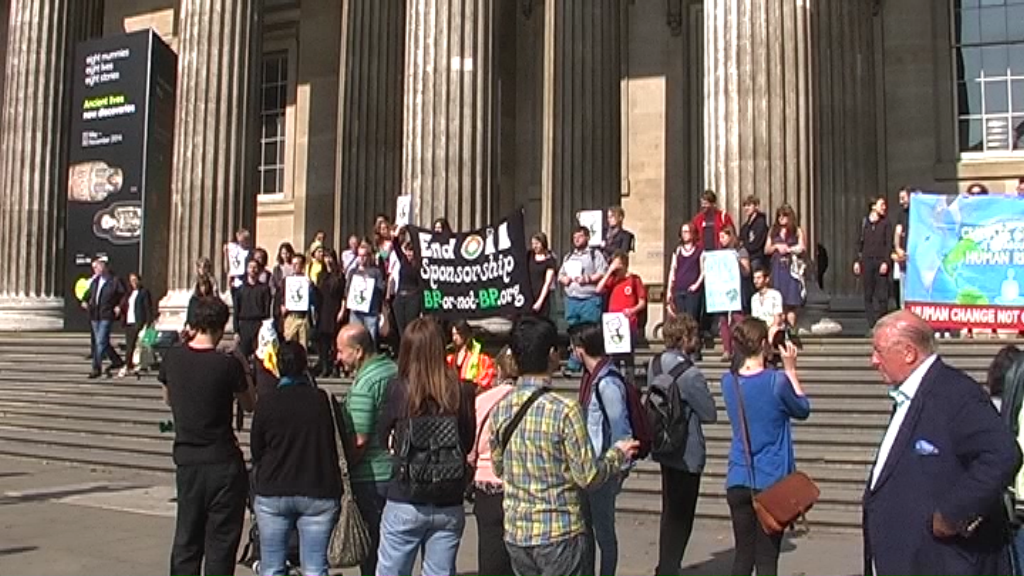
As their trial began last week, a solidarity demonstration of over 60 people including Green Party leader Natalie Bennett, was held outside Willesden court. With banners, giant inflatable cobble stones and solidarity songs we created “the best atmosphere at a court demo I’ve ever seen” according to one participant. The 30 seat public gallery at the court could not hold all those who wanted to observe. And as the guilty verdict was given on Monday people again gathered to show their support. But why am I telling you all this? Why does solidarity matter?

Building up your capabilities and overcoming your fears to take action is sometimes just the beginning. To know that your work is supported and that people will stand by you will make everything that comes next easier. After their arrest, the 13 have travelled back and forth to court, prepared their defence, been through the court system and been cross examined. If they are imprisoned they will become the UK’s first climate prisoners. But there will be many more over the coming years. With climate changing emissions still rising, direct action from the public (for example Groundswell) is also on the up, with increased numbers of people risking prison sentences.

If imprisoned for more than a few weeks you may be unable to maintain payments on your accommodation or fulfil your obligations to your job. As a result many people lose their home and job when they go to prison. Amongst the Heathrow 13 are a lawyer, a environmental scientist and an atmospheric physicist, who all risked their jobs to defend our future and life on this planet. Whether you send an email of support, write a letter to your newspaper, attend court, bake cake, donate money or offer work to those who lose jobs, the support of the environment movement is essential and deserved by those who take risks for the sake of us all.

The defence case was based on the premise that the 13 were defending life with their actions. The judge however refused to allow them to call expert witnesses on climate change, saying that she accepted the threat of climate change but that she did not accept that their actions were to save lives, and were instead symbolic.

As she gave her guilty verdict, the judge called the 13 “principled people”. History is made by principled people taking action. All it will take for a collapse of the ecosystems of this planet is for good people to do nothing. We live in an unprecedented generation of information and choice, where we can no longer avoid responsibility. Although the system we live within makes denial easy and action hard, we can take inspiration from those who do act, and we can give them our full support and solidarity when they do.

How do you practice a resolution?

On one point I disagree with Jedi Master Yoda. There is a try. I’m not saying that effort alone, without wisdom or strategy will win the day, but if you’re thinking of making a resolution this year, I’ll invite you to look at it a little differently. If we’re trying to change the culture of destruction, a good start could be getting the hang of changing ourselves.

For any behavioural change you’re looking at at least a year to make it habit, so the first thing to realise is your resolution doesn’t ‘fail’ the first time you don’t do it. That’s exactly what’s supposed to happen, it’s just the start. You don’t ‘keep’ a resolution, you practice it.

To help your resolution succeed here are some tips:

  • Understand the emotions behind why you want it
  • Make yourself accountable by telling others
  • Use role models, supportive people and positive peer pressure
  • Plan the details of how you will do it
  • Record and monitor your progress (we all love those little lies we tell ourselves)
  • Be positive and encouraging to yourself when you manage it AND when you don’t. The point is to keep trying
  • Don’t set unrealistic aims, no one is perfect, so plan for imperfection
  • Only do one big change at a time

persistentThe devil’s in the detail, but so is success. If you’re trying to do something you weren’t able to do before, there are probably some good reasons why it was hard. So how do we plan ways around these?

What are the trigger events that tend to make you slip? What are your detailed plans to deal with these? How are you going to get back on track? What motivational rewards can lie in store for you? What tips and plans could you share with others to help them?

To encourage us to help each other, if you share this post on Facebook with your resolution and a tip for how you’ll practice it, you could win a free copy of Pollinating Change. The people posting the five most interesting tips before the end of January 1st will each get a free book.

If plan and persist you do, succeed you will! Hmmm!


Ding dong climate defenders!

As New York City reached 22C three climate defenders entered their not guilty plea at Uxbridge Magistrates Court yesterday to climate carols and support from locals.

In late November the three people blocked the road to Heathrow Airport in protest of airport expansion and to highlight David Cameron’s promise of “No if’s no buts, no new runway”.  For blocking the road they are charged with breaking a local by-law and are pleading not-guilty as their actions were to prevent a greater harm.

The defenders will be told the date of their trial on the 6th of January. On the 18th of January the trial for the Heathrow 13 begins at Willesden Court.


Jingle bells, expansion smells, block it all the way.

Keep jingling those bells. Merry Solstice and Christmas to you all!


Doing what frightens you

Since the Buzz Tour I have run several workshops for groups and individuals about overcoming fear. We all feel fear differently at different situations depending upon our capabilities and previous experiences. There is useful fear which gives us fight or flight hormones to deal with emergencies but there is also unhelpful fear that we can develop techniques to overcome.

shipharbour

  • Reducing risk
  • Using motivating emotions
  • Be inspired
  • Use habit and familiarity
  • Taking care of the physical
  • Courage together

Reducing risk

Risk is composed of probability and consequence. Simply doing something that frightens you will not reduce your fear of that thing unless it makes you more capable, increases your knowledge/familiarity or it goes well. Doing something badly and having your fears confirmed can be traumatising rather than helpful. The first stage to doing something frightening can be to reduce the probability and consequence of harm. Knowledge reduces the fear of the unknown. Finding a mentor, learning from others and practicing also reduces fear. By becoming more capable and managing the situation to the best of your ability you make the reality less frightening in real terms.

Using motivating emotions

When considering how to grow our courage we are exploring a behavioural change, which by necessity must involve motivating emotions. Develop and use your motivating emotions – gratitude, devotion, duty, love, anger, frustration. Why are you compelled to do this thing that frightens you? Explore and visualise your motivation so it can be recalled when you need courage.

Be inspired

Use the inspiration of others. Who can you use as role models to give you a template for your courage? Emotionally connect with what they did in order to normalise what you are about to do. Human like to follow and copy each other so use that to your advantage.

Use habit and familiarity

Humans have a useful ability to go on ‘autopilot’ and the more we are familiar with a situation the less stressed we are. If you are going to have to do something in a frightening situation can you do the activity hundreds of times so that you can use the habit to do it with little conscious effort? Can you bring familiarity and normality with you into the fearful situation in order to reduce stress levels?

Take care of the physical

Some physical situations will lead to more fear and stress so taking care of the physical needs makes courage easier. Eating (especially carbohydrates), sleeping, keeping warm, not abusing substances, resting and removing stress hormones from your body will all help reduce fear and anxiety.

Courage together

There are many factors that make it easier to have courage in a group. Our bodies release more reward hormones when we take risks with a peer group than alone. The immediacy of protecting our friends is motivating and you have someone to literally watch your back. The social pressure to perform and conform in front of others and group pride is also a useful tool. For these and many other reasons we must pick our peers with care, communicate our wants, limitations and fears, and take responsibility for each other.

When we have done all we can to reduce our fear, there may well still be a gap that remains, between our courage and what we need to do. Never give in to self pity. When there is nothing left for it, stop thinking, use your motivating emotions and just do it.Do-You-Have-The-Courage-to-Price-High


Arriving as yourself

how_to_better_yourself

Everyone who came to Paris made some kind of sacrifice to be there, but how do we ensure that as we take leaps forward, that we are still ourselves when we arrive?  In this long distance relay run to save ourselves, we need to look after each other to reach the finish line.

Our identities evolve over time and encompass our behaviour and habits, which are highly influenced by the immediate culture we live in.  The environment movement learnt some painful lessons from the Copenhagen COP. This time discussions were about ‘beyond Paris’. Everyone was aware of the trap of pinning hopes on governments or burning yourself out for the sake of just a couple of weeks. But even with that awareness, some who were there for weeks or months still found they were not themselves by the end. An awareness of the global crisis, unheated squats, terrorist attacks, police raids, organisational crises, late night noisy parties, and no defined breaks were just some of the challenges.

Creating a sustainable culture of resistance involves prioritising the basic support infrastructure – food, shelter, sleep. It also involves organising ourselves to reduce the stress of situations and respecting other people’s needs and valuing rest. A tendancy I observed was for people to get sucked into a habit of not taking breaks. When there are no organised rest breaks and no ‘work free’ areas it’s hard to relax because around you other people are stressed and you feel guilty. The use of alcohol and other substances for stress relief is only effective in the very short term as the body becomes resistant and leads to further stress on the body the next day.

When people become stressed over a prolonged period of time, the hormone cortisol builds up in their bodies, causing harm. Decision making becomes impaired and further stress is caused by the resulting bad decisions. To avoid serious damage there must be periods of time where hormone levels return to normal. Dancing, shaking and laughing are good ways to remove cortisol from the body.

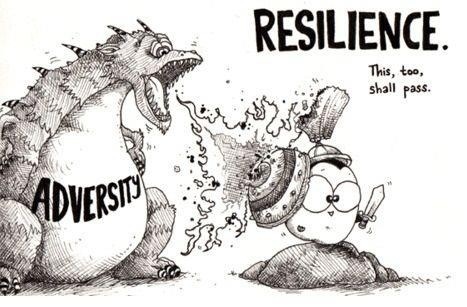
resilience-cartoon

Some tips for arriving as ourselves:

  • Take care of the basics – food, sleep, shelter, exercise and time in nature
  • Plan effectively. Anticipate things that may go wrong and arrange spare capacity
  • Learn to let go, to delegate and to put people and processes before outcomes
  • Never feel sorry for yourself. Embrace your power and do not regret
  • Celebrate, forgive and be grateful for yourself and each other
  • Value and make time to be kind and loving to each other
  • Avoid the use of substances for stress relief except for the very short term
  • Remind yourself of the broader long term perspective. It will pass
  • Practice resilience and self care when it is easy, so that when it is hard it has become habit
  • Take breaks with friends and reinforce a subculture of resilience
  • Invite and be grateful for the wider support of the community

Over the next ten years the tactics, work and results of the whole environment movement will evolve. It is my hope that as we take power of our global culture, as we succeed in creating the world we want to live in, that we will arrive there as the people we wish to be.


How do you draw a red line?

Where’s your red line? Is it when half the animals on earth have been killed? Is it when three quarters of the commercial fish stocks collapse?  Is it when the oceans acidify? Is it when only 15% of the world’s forests remain intact? Is it when record-breaking storms, fires, floods and droughts rage worldwide?

The closing ‘red lines’ protests against the COP21 climate deal had a message that the public would hold the global governments accountable and that they would have the last word. Governments have made a voluntary, non-binding agreement to begin to reduce emissions in 2020. Although negotiators agreed that warming should be limited to 1.5 degrees  and must be limited to 2 degrees there is currently no plan to make that happen. There are many times more reserves of fossil fuels than can be burnt and no governmental negotiations yet about who keeps what in the ground and who compensates who for climate change. So if we are to be responsible to each other and future generations how do we ‘keep it in the ground‘ and meet the COP21 target?

resize

As well as divestment, community initiatives and political campaigns, internationally plans are growing for 2016 to be a year of direct action, interrupting fossil fuels at the sites of extraction. This year German coal mines were repeatedly shut down, including the Ende Gelande 1500 person mass tresspass which resulted in the hundreds arrested being released. In contrast, just nine people in the UK temporarily closed a coal mine owned by climate denier Matt Ridley and eight of the group have now been sentenced to a total of £10,000 in fines for which they are crowdfunding for help.

A UK project called ‘Groundswell‘ is now emerging to increase the interruption of fossil fuel extraction in 2016 but as more people step up and step forward in defense of their red lines, the question emerges, how do we prepare now to make our movement sustainable and strong for the coming storms?

Performing the peace

December 12th’s ‘D12 Redlines’ mass mobilisations in Paris, were peaceful and from the outside this may appear to be good luck or an uncharacteristic kindness on the part of the police. I’d like to share with you the behind the scenes hard work of around 80 activists that lead to that peaceful protest and what we could learn from these techniques.

After the Paris attacks a major focus of the climate organisers of the D12 Redlines protest was to prevent further violence and trauma. An ‘action consensus’ was agreed and publicised that all those participating in the redlines action were agreeing to non-violence and non-escalation for that event, but simply stating it, does not make it so. Everyday the police would change the restrictions around protest meaning that day after day the plans would be redrawn. The largely muslim communities living around the conference center at Le Bourget were and are still suffering police repression and the decision was taken to move the protest elsewhere. Sometimes ten hour long meetings would be attended by activists from direct action groups and NGOs from around the world to decide the style, messaging and location of the civil disobedience. Eventually a commemoration of the climate dead and public commitment to defending the ecological ‘redlines’ was agreed.  2-590

On the day itself, there were around 60 people working on ‘de-escalating’ the police. Groups trained by Theater of the Oppressed had practiced emotional connection choreography kept themselves between the police and the crowd and kept the atmosphere one of peace through their hard work, even when the police started to get out the tear gas. Women dressed as climate angels kept a dignified solemnity and were prepared to resist police charges and tear gas. Some of my favourite memories were also from the clown groups. One pair of female clowns was blowing bubbles into each others face and then at the police. I saw one policeman restraining a smirk and dodging his head slightly so the bubbles did not burst on his face.

Another pair of clowns were following undercover police and identifying them to the crowd. The police looked very aggressive, were masked and wearing black. The clowns were mimicking and mocking them, pointing to them and telling people that they were police. After a time the police had no choice but to leave the crowd and their orange armbands saying ‘police’ were visible.

The day before, the police gave in to organiser demands and made the thousands participating in the protest around the Arc de Triomphe legal and therefore no longer civil disobedient. However, the need for participants and not just organisers to challenge the protest ban and make the conflict visible still existed, and without an outlet, violence may well have ensued. Groups led a push to march to the Eiffel Tower to join up with the legalised protests there, managing to block roads and take the space so that the crowd could march. One of the tools that helped keep the peace was the use of giant inflatable ‘cobblestones’ which were also simultaneously used in London and several other cities.

The inflatables bounced along the top of the crowd as they marched and made it quick to take a space without seeming threatening (although they would not have worked in windy weather).

At the Eiffel Tower I saw a military column of gendarmes (armed riot police) and you could see the crowd around becoming nervous. Then a troupe of clowns arrived and standing in front of the gendarmes, with their backs to them, began to pretend to be an incompetent military company, turning the wrong way, falling asleep and being disciplined. The crowd all turned to watch and the gendarmes quietly melted away. By clowning to the crowd, the performance was empowering without being directly confrontational to the police. An earlier clowning had included waving things in the police’s faces and more confrontational shaming which led to an escalation rather than de-escalation of tension. When choreographing emotions I think we need to be very careful how we use an emotion as powerful as shame, to avoid a defensive reaction of anger.

Climate-500x330

From what I saw in Paris there are good skills already around emotional choreography that we can use to combat increasing repression and state violence but there is an open playing field awaiting innovation. There is a great deal we can learn from resistance movements operating under dictatorships. How can we make the social cost to the state of violence against it’s people too high for them to want to pay? How can we use the moral high ground that we already hold to the best advantage?

It seems increasingly to me that the line between artist, performer and activist are blending and disappearing. Some of the finest hours in this field of work and the finest performers are perhaps yet to join the fray. The mainstream media does not have the space to examine this work so I salute and celebrate those performing the peace. Thank you for all the essential work that you did to keep us safe. I look forward to what you come up with next!

Civil disobedience, from Paris with love

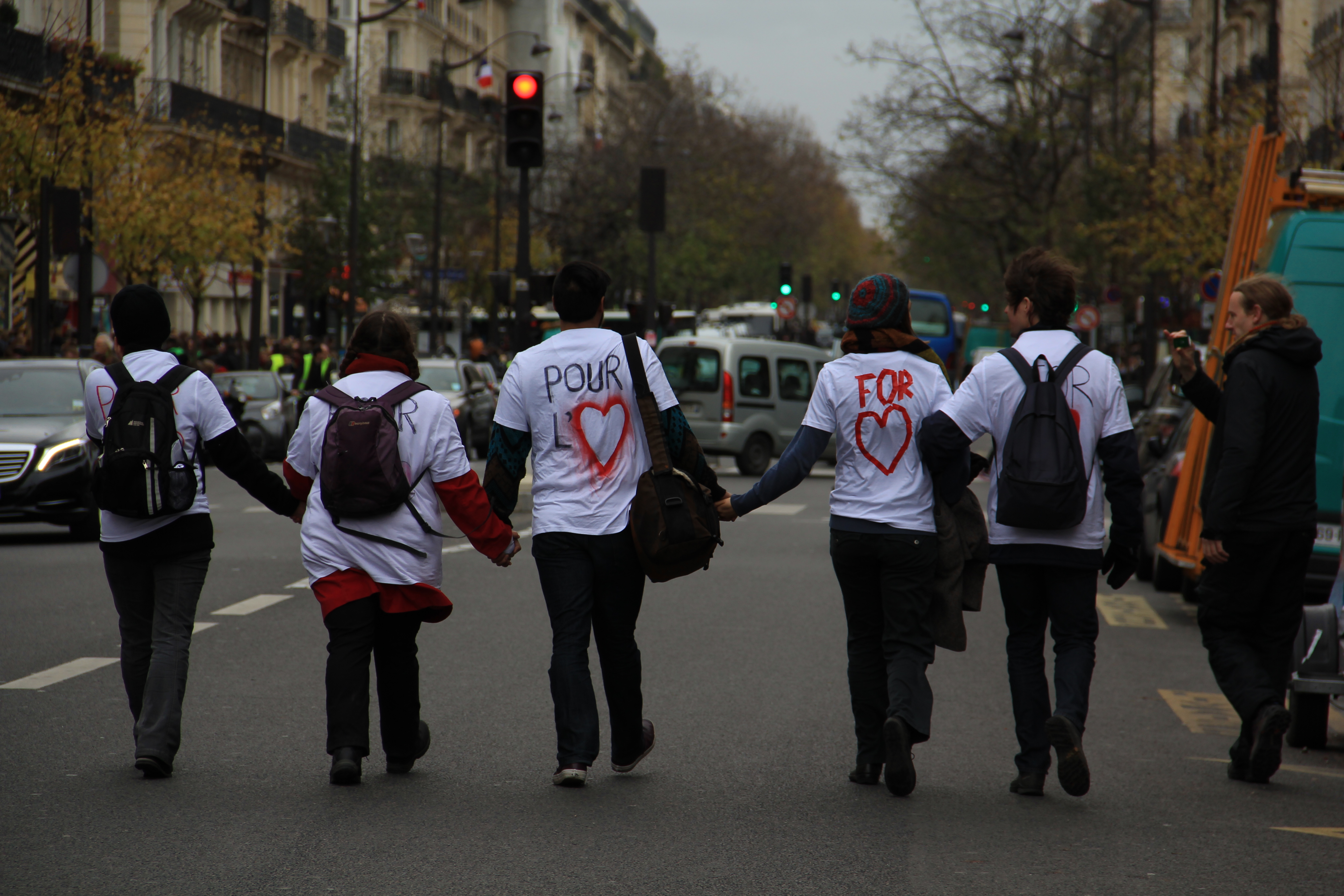
Civil disobedience is doing an activity which is illegal because you believe the law to be unjust. For example a black person sitting in a white-only bus seat, or a person protesting when protest is banned. Miranda and I took to the streets of Paris to march for love of humanity and our planet in defiance of the protest ban.

IMG_4512


During the first twenty minutes of the walk I was on the phone to Radio Woking and you will be able to listen to the interview online soon. Along the route of the march we saw the length of the human chain and had a range of responses, mostly very positive.

A brass band also later led a group of people into the streets to march. The police initially kept pushing us off the road and we kept returning but after a certain point they decided to leave us to it and we were able to complete the march. Ten minutes before the end, our spirits were further raised by seeing Brandalism posters still up along the street. And we kept walking…for love.

IMG_4520

Paris protest and mass participation

So far the state of emergency in France means that the government has forbidden public mass gatherings like the climate march, they no longer require warrants for searches, can forbid the movement of people and vehicles at certain times and places and can censor communications believed to facilitate terrorism. What might this mean for climate activists in Paris and what are some of the tools available to us? legogatheringOn the metro the other day I was passed by about thirty soldiers with guns walking in line and glaring sternly at everyone. Yesterday I had my backpack checked going into the supermarket. The people I meet have not been deterred by the threat of terrorism from living their lives as normal and we remain in a western country where protest is very low risk compared to much of the world. As legal restrictions increase there is a lot we can learn from protest strategy elsewhere in the world to allow the maximum number of people to participate.

Positive change can come from our constructive actions to create a new reality, but it also comes out of resolving conflict and stopping harm and abuse. Those with power who benefit from inaction on climate change are in conflict with those suffering because of climate change, and indeed the rest of life on earth. The behaviour of vested interests such as Esso has shown that they will not change unless forced to. These points of conflict can be worked on in a wide range of ways but some tactics are especially suited to mass participation in times of reduced public freedom.

Protesters brandishing shoes during a demonstration to demand the resignation of Tunisian Minister of Women's Affairs, Sihem Badi on March 29, 2013 in Tunis. Badi is highly criticized for months for her good relations with the Islamist ruling party Ennahda and recently for her support to a kindergarten where a three-year-old girl has been raped. AFP PHOTO / FETHI BELAID In a ‘virtual march’ shoes, pictures, footprints, banners and toys may be used to represent the dead or those not able to march. Those marching elsewhere can carry pictures in solidarity. When mass gatherings are forbidden a distributed action is one which happens simultaneously at a large number of locations.

If public spacescafe are forbidden, privates ones such as shops, cafes, theatres etc may be used. For those accepting of a greater level of risk, ‘forbidden’ actions are available. Civil disobedience is the deliberate non-compliance with a law believed to be unjust.

Where organised protest is forbidden, other signals can be used which are hard to classify as a protest. For example, gathering and all wearing a symbol, using a certain ringtone, making public noise at an arranged time… Humans are endlessly inventive in our communication and if the risks outweigh the benefits for one form, others may be devised.

There is of course also a huge range of disruptions which can be directly used for those causing harm. Over the next month hundreds of thousands of people are considering how they will make climate conflict visible and work to resolve it. Behind choices of tactics they will be considering who are the targets we want to change, and what are the levers we are seeking to influence to make that happen?

If you’d like further reading about strategic non-violence try Blueprint for Revolution and for tactics and strategy you might enjoy Beautiful Trouble.

Buzz Tour in Paris

I arrived in Paris on Friday evening but was inside for the night before the murders began. Over the next month Buzz Tour will be reporting from Paris, bringing you interviews and articles about the people gathering to work to reduce climate change, but in this first report can only express my condolences to all those injured and those who lost loved ones.

On Saturday I saw soldiers outside a synagogue and assumed it was because of the killings but my companion told me that Parisians have been living with soldiers outside some places of worship and schools since last January’s terrorist attack. I spent today walking from one side of Paris to the other today then catching the buses around. In the unseasonably hot, sunny weather people went about their Sunday business and the street cafes were busy. Tourists packed the areas around famous sites and families were using the many parks.

peaceOpposite the Porte Saint-Denis (built to celebrate Louis XIV’s war victories) a homemade banner call for “Paix Amour” – Peace Love – with the Eiffel Tower peace symbol. The Eiffel peace symbol was also showing on electronic screens in the spotlessly clean business district amongst the glass high-rise towers.  The number of homeless people living in poverty on the streets across the rest of the city is very high, most of them black.  Cardboard corrals and tent shanty areas pop up now and then anywhere, even next to the Commerce building.

Hundreds gathered in Place de la Republique for a peace vigil this evening. Looking out of my window I can see the Eiffel Tower in the distance,  tonight relit after being dark in mourning yesterday.


What’s happening at the COP21?

Want to connect with the biggest climate meetings and demonstration of our time? The 21st UN Framework Convention on Climate Change Conference of Parties (COP21) is a focal point for people from around the world to gather. The talks begin on the 30th of November and finish on the 11th of December but grassroots events are already happening and will continue after the talks. Here’s a look at what’s coming up.

On Saturday 28th and Sunday 29th in all major cities across the world are the climate marches. If you want to organise your own local demonstration a good place to start is 350.org.

The Climate Games, the “world’s largest disobedient action adventure game” runs from the 30th of November to the 13th of December. Before that, teams need to anonymously register and pick a target. You can play anywhere in the world especially for the opening round on the 30th of November and teams will win points for their actions. Here is an excellent toolbox for disobedient actions to give you inspiration and more information.

In Paris you can find out more about the dozens of workshops, gatherings and talks on the website of Coalition Climat 21, the French-led coalition of over a hundred different groups. On the 5th and 6th of December the Peoples Climate Summit will have the largest concentration of events, just to the east of Paris in Montreuil. Between the 7th and 11th of December the Climate Action Zone will help people to form groups and to prepare to take actions against those worsening climate change.

climategamesAs well as the games, on the 12th of December in Paris there will be the largest European civil disobedience on climate change in history. This will include a ‘red lines’ action where streets will be blocked with inflatable red lines that represent the ecological ‘red lines’ that should not be crossed. After the summit groups will return home with their new skills and friendships to prepare for a actions in spring 2016 against major global warming gas emitters.

If you’d like to go to Paris you can arrange your own transport or Reclaim the Power have organised coaches. In Paris there will be free ‘crash space’ organised by Reclaim the Power for which you will need to bring a sleeping mat and bag. If you would like to arrange your own accommodation we suggest you are quick! If you would like to cycle there you can book your place (including accomodation) with Time to Cycle.

In the words of the Climate Games, get ready to make your move!

Cycling to the Climate Talks in Paris

Buzz Tour’s Sama explains how she’s preparing to cycle to Paris and invites you to join her with Time to Cycle.

We are five weeks away from the start of the COP21, the 21st climate talks held by the UN, and my heart is bubbling. Since the first of these conferences, CO2 emissions have gone up by 63% and we are further than we ever have been from protecting the species on this planet. But in these grim times, I feel excitement.IMG_5343
During our five-day mass ride to Paris, subgroups will cycle together an average of 40 miles a day and work together.  The ride in December will be physically and mentally challenging. Training and information about the mobilisations taking place in Paris will be shared during the ride and the cyclists will arrive in teams, ready to take part in a way that suits them. The negotiations end on the 11th December, but the human affinities, challenging experiences and shared stories remain.

To avoid the rising of temperatures, we must keep fossil fuels in the ground. The bicycle is a beautiful example of how we can do this. Affordable, healthy, enjoyable and cleaner, it is a way of slowing our lives down and appreciating what is around us without having a negative impact on others.

There are still places left on the ride and deposits need to be in by the 1st November. We are encouraging everyone to get sponsored and reach out to those who are unable to come but can have their messages taken to Paris through this ride.

Find out more on www.timetocycle.orgSS852204

Sama 

Time to Cycle

Countdown to Buzz Tour documentary

In twoScreenshot from Buzztour tape 10.avi - 5 days you can watch the one hour film for free online, download and share. Please help us create a buzz around its release by sharing it widely. The film has been screened in fifteen towns and cities around the country as well as at The Green Gathering, receiving great reviews.

Inspiring and uplifting…the film has really given me a lot to think about…thank you so much for sharing your wonderful journey…some documentaries can leave you feeling depressed but I felt so positive and inspired afterwards, thank you!

The film represents a sampling of the amazing people and projects encountered during the Buzz Tour. For the full story, you can use the free resources on this website or you can buy the book online. Both the book and the film focus not on what obstacles lay ahead of us, but on how we can overcome them together. The kindness and hard work of people all over the country made the journey possible. Ten different companions walked on the tour with an hour of silence each day, living off donations, and some of their video diaries are also in the film. Screenshot from Buzztour tape 4.0.avi - 7Over the course of five weeks I had the tough task of whittling the twelve hours of footage from the walk down to one. We interviewed over ninety people and there was hardly a village I walked through where someone was not doing something wonderful. Jade Neville kindly edited the final footage together, Formidable Vegetable Sound System donated their music for use in the film and it was filmed on a camera loaned by Insight Share.

I look forward to being able to finally share it with you.

Screenshot from Buzztour tape 11.avi - 2 Screenshot from Buzztour tape 10.avi - 10  Screenshot from Buzztour tape 9.avi - 1 Screenshot from Buzztour tape 4.0heath.avi - 1


Grow food everywhere

layaAt the end of August I spent two weeks studying a Permaculture Design Course (PDC) in beautiful Cumbrian countryside. Living, eating and studying with 18 other people all wanting to make the world a little better. After completing our designs, receiving our certificates and putting on a riotous evening of entertainment, we all went back out into the world. It is estimated that over a million people worldwide have now taken a Permaculture Design Course.aframe I think about the people on that course, and  all the others like it all over the world taking those ideas and trying to use them, and I like the thought very much.

I’ll be practising making permaculture designs for others over the next DSC_0125two years but the first place to start is with yourself. Since for the next year I’ll be in one place, I’ll be starting with the patio outside my door. There are quite a few foods that can be planted in the autumn so even I, without soil and with a whole lot of shade, should be able too grow things. To start with I’ll be planting welsh onions (perennial), pak choi, perpetual spinach and wild garlic.

It’s been 40 years since Permaculture began and this year the International Permaculture Convergence was in the UK. The ripple effects to the UK from having hosted this gathering should be very pleasant to watch over the next few years. Go on, grow food everywhere.

compostdesignclosedogemerges

Permaculture fortnight

bridge-copyToday I begin my two week Permaculture Design Course in beautiful Cumbria.

It’s part of my two year plan to combine permaculture principles with plumbing skills to be able to offer water management and design in harmony with the ecosystem.

PDC_design_PrinciplesPDC_raised_bedsulpha_school


On my travels I’ve found a lot of environmental projects that are struggling to find the plumbing and engineering expertise they need. It seems that most of the plumbers aren’t interested in the environment and most of the environmentalists don’t know plumbing. That sounds like a thing to change! Those of us on the permaculture course now have two weeks of camping, eating and studying together to learn the principles that we will later use in our own projects.

Support the Heathrow 13

Sama and Eve have started to collect funds for the travel and other expenses costs of the Heathrow 13. You can donate to support these lovely people on our new campaigns page. Please put ‘Heathrow’ in the reason box. Let’s show our gratitude for their bravery and for making sacrifices for all our sakes. Thank you to the four early birds who have already donated!

no3rdrunwayThey live in different regions of the UK and will have to travel to meet their solicitor, witnesses and each other in order to prepare for their two week trial starting on the 18th January 2016. This is time and energy consuming, as well as expensive, but we can support them and reduce the burden.

If you would like to volunteer to support the Heathrow 13 in any other ways please get in touch with us. Thank you!

A happy polar bear

no3rdrunwayThis morning I was a very happy little polar bear. “No ifs no buts, no third runway” we shouted. Standing outside Uxbridge Magistrates Court with forty other people I supported the climate activists who were arrested last month protesting against airport expansion. The 13 brave folk pleaded not guilty to aggravated trespass because of the greater climate crime they are trying to prevent.

You can watch a video of Sheila’s statement that she read outside the court. Check out my happy polar bear protest sign. Don’t want to wait for a paint to dry? Try chalk, tipex and hairspray instead.

The UK climate targets will only be met if we do not allow airport expansion. The vast majority of flights in this country are from a small minority of very frequent short haul flyers. For example those with second homes who fly to them at weekends. Policies such as stopping frequent flyer discounts and introducing a frequent flyer tax would help us reduce, not expand airports. No ifs, no buts, no more runways.