
Visiting the permaculture garden at Tapley Park is a beautiful experience not just because it looks great but because the layers of fruit trees, shrubs and other plants strengthen and add to each other so that they grow better together. The word permaculture come from permanent agriculture, a way of farming that works with the ecosystem rather than in conflict with it. By combining species and not using artificial fertilizers or pesticides, farmers are able to get food whilst building soil and increasing biodiversity. We’ll see a lot more of these ideas during the tour!
Category Archives: Food and agriculture
GMO no
Visiting Tapley Park near Instow would be a treat anyway, but meeting Hector Christie is a delight. His enthusiasm for people, the environment, highland cattle, playing football and mischief can’t help but make you warm to him. For several years Hector’s battle has been against Genetically Modified Organisms (GMOs).
Hector explains to me that the safety concerns regarding GMOs also extends to the system within which they are used. Often the reason for modifying the organism is to make it resistant to a pesticide so that stronger pesticides can be used to remove weeds. The best selling pesticide Roundup is made by agrochemical company Monsanto. The active ingredient glyphosate is safety tested, but the final product is not, yet other ingredients in the product called adjuvants break down the cell walls to enable the glyphosate to enter and kill it. This means that the final product behaves differently to what is safety tested. Following the public outcry in the UK about GMOs they were rejected by many food stores, but they have been quietly creeping into our food. There is no requirement to label them and most of us are unaware. Hector is organising a national demonstration against GMOs later this month on May 20th and demonstrations are taking place all over the country.
Then on May the 24th there will be an international day of demonstrations and marches against Monsanto to Get Monsanto Out.
Horses for courses
A couple of days ago I was walking through the woods when I came accross a beautiful shire horse, all harnessed up. It turned out that he was being used to drag Sitka Spruce trees out from the wood to increase bidiversity and for use in a biomass boiler! The man conducting the operation was John Williams who was well aware of the value of maintaining traditional practices.
We’ll have more of a use for these horses as fossil fuels decline with peak oil.
You can see the horse in action here.
Then just yesterday I met Jonathan who runs a gorgeous B&B called Higher Bidicott Farm, where he farms with horses and has done all his life! He trains around three working horses a month for other people so that they can be used on other farms too.
Natural beekeeping
Phil Chandler AKA The Barefoot Beekeeper, is obsessed with bees. And with good reason, these amazing ceatures are the foundation of our foodchain, with our foods having been selected over millenia by the actions of bees. What is Natural Beekeeping I asked him and why is it different from the more commercialised style?
In Natural Beekeeping the emphasis is on a respect for the bees and not interferring anymore than is necessary. Rather than taking all the honey and replacing it with a sugar solution, the beekeeper takes only the excess honey that is available and avoids disturbing the hive. Because bees create honey as a food for their babies it contains all the things that they need, so they are stronger if they are able to eat it. The hives are carefully contructed by bees to minimise the risk of airborne diseases, so avoiding opening the hice helps to allow the bees to control the environment inside. You can learn more about natural beekeeping and visit the discussion forum at www.biobee.com.
If you are also interested in supporting the protection of bees, Phil is a founder of Friends of the Bees.
Oxford practice walk
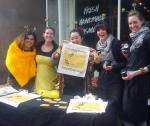 Lush threw us a fundraiser in Oxford this weekend, raising £57 for us with sales of their Charity Pots.
Then we visited bike co-op Broken Spoke, and set out along the beautiful canal and Port Meadow and passed the ruins of Godstow Nunnery.
Further out we found Fai Farms providing artifical bee homes. You could provide living space for bees in a similar way. 
We passed Wytham Woods a Site of Special Scientific Interest where the habitat is being preserved.
In total the four of us walked about 35km, mostly on the second day which was a good long  practice!
 Buzz tour