A change in the flight pattern of the RSPB

In the Bedforshire town of Sandy we found a great bird habitat reserve, but we also found the headquarters of the RSPB (yes, we really are that lucky/disorganised that we didn’t plan it that way). Like perhaps many people I viewed the RSPB (Royal Society for the Protection of Birds) as focused only on birds, but what the reserve manager explained to me was that to protect the birds, you have to protect the habitat. Without the whole ecosystem, the birds don’t stand a chance. Sounds similar to the situation of my favourite upright primates…

The RSPB’s message has now changed to ‘Saving Nature’ to better reflect the work they’ve been doing for years. As someone who doesn’t know their bitterns from their sandpipers, but fervently wishes for the survival of them all, the broader systemic focus catches my interest. The RSPB is one of the biggest landowners in the UK and provides the habitat for over 80% of our threatened and endangered birds. They also have over a million members, so when they speak, people listen. Say it loud, say it proud RSPB, it’s time to save nature.


 

The restoration of the fens

Did you know that the National Trust is the second biggest landowner after the Ministry of Defense? I didn’t. Why would an incomeless environmentalist like me decide to become a member of the National Trust?

I did not realise that the National Trust does a large amount of work to protect the environment, it turns out it’s not all about posh manor houses. When the National Trust staff kindly told us about the ambitious work happening at Wicken Fen, it was enough to stir me to part with the little money I have to support what they are doing.

Fens are wetlands that are fed by mineral rich waters. Wicken Fen is the oldest National Trust reserve in the country and one of the most important wetland habitats in Europe. Walking through the landscape of the fens the rivers are a lot higher than the surrounding land. Weird. You might think that perhaps they were built up that way? It turns out to be the other way around. When the fen ditches were dug and the land drained, the layers of organic matter that had been laid down over thousands of years were exposed to oxygen. With the oxygen the carbon started to break down and release carbon dioxide into the atmosphere. Another surprise. It turns out that draining wetland is very bad for our climate as well as removing habitat. But what the National Trust have planned gave me a lift of excitement.

Most organisations and politicians seem to think a few years ahead, maybe a decade ahead, but the National Trust have a hundred year plan to restore fenland around Wicken Fen. By gradually buying up the land, they will restore  this vital habitat, lock up carbon and protect it for the benefit of all.


Give us a smile Oxford!

out of oxford

We realised during our practice walk through Oxford that it is packed with people taking action to protect the environment. We spoke to Rupert Griffin about his achievements in getting more local food available in Oxford.

Rupert now runs his own business providing local apple juice and honey.

You know when you smile at a stranger and they smile back, then you smile more, and there’s a shared moment. Those are the moments I wait for but strangely there was only an average of 10% smile return rate through Oxford. One man surprised me by cycling back to me to thank me for smiling at him and it made my day. Just keep smiling people, sometimes they smile back. 🙂

keep smiling


Ethical investment – divestment

A cancer research charity would not invest in tobacco, it would be unethical. A peace group would not invest in arms. Where you put your money is where you put power, so if we want to create a healthy future we can’t invest in unhealthy things.

Money is a bit like energy, it’s only doing something when it’s flowing, so organisations and banks are constantly investing, and some of that money is going to fund the expansion of fossil fuel drilling. Even if we spend all day campaigning against climate change, our money may be quietly funding climate change. The process of removing money from unethical investments is called divestment.

The campaign for fossil fuel divestment worldwide is Fossil Free, and there are campaigns all over the UK. I spoke with Al about her work on the Fossil Free Oxfordshire campaign.

In Oxford on the 31st of May will be a rally to call for the City Council, the County Council and the universities to divest.


A very respectable no-water closet

Near Northmoor Lock on the river Thames we came across Barefoot Campsites, with picnic tables, yurts, small sheds, and two very presentable composting toilets made by Free Range Designs. A common concern with composting toilets is that they might be considered unpleasant to use but I suspect these will please and surprise many a person.

A hemp for all people

Sometimes I know where I’m going and who I’m meeting, other times I know where I am and who I want to find.

In Glastonbury I set about asking people in the town, who’s passionate about the environment in the town?  They directed me to Free, a man so passionate about the uses of hemp that he changed his name to Free Cannabis. Other than it’s more well known use for those with chronic pain, hemp is an exceptionally nutritious seed, a fabric, an insulation, a fuel, a building material and an ingested medicine. Free runs the hemp products shop in Glastonbury – Hemp in Avalon.

Horses for courses

A couple of days ago I was walking through the woods when I came accross a beautiful shire horse, all harnessed up. It turned out that he was being used to drag Sitka Spruce trees out from the wood to increase bidiversity and for use in a biomass boiler! The man conducting the operation was John Williams who was well aware of the value of maintaining traditional practices.

We’ll have more of a use for these horses as fossil fuels decline with peak oil.

You can see the horse in action here.

Then just yesterday I met Jonathan who runs a gorgeous B&B called Higher Bidicott Farm, where he farms with horses and has done all his life! He trains around three working horses a month for other people so that they can be used on other farms too.

A passion for transport

By accident I stumbled accross E & TVR. These mysterious letters signify the Exeter and Teign Valley Railway. A railway that was dismantled not because it was unprofitable or because it was unused, but as part of a government policy which happened decades before I was born. Colin Burges has made it his lifes passion to campaign for a reinstatement of railways, especially those that are largely still intact. He sees a future where cars are off the road and people and goods are back on the rails.

The E&TVR visitors center is a whimsical and sometimes darkly funny look at his love of the railway and desire for a more environmentally conscious transport policy – the thing that caught my eye was a crushed car labelled “The only green car”! I spent the night in the beautiful minature railway car, Tadpole, which was lovingly made by Colin and normally sleeps children whilst adults often book the larger Toad. As well as the restored line, loading yard, and information hut there is also a small rail car that children can take rides in. Located next to a beautiful river, it’s a very peaceful spot.

If you are nearby I would heartily recommend learning from the displays and from the very knowledgeable Colin himself. I give you fair warning though, don’t expect an ‘easy ride’ if you arrive by car! 🙂

Educating to learn

Acorns learning at Oakwood Denbury is an outdoor leaning center run by a family. Steph and I arrived to find an outdoor fire, a long table with food and friends celebrating with their children. I won’t tell you too much about the center but rather invite you to go and experience it. With food growing and an equal weight on emotional literacy as well as numeracy. Sharona one of the founders shared this with us:

We’re all on a journey as humans. I really felt alone but now there’s a feeling that we’re in this mass community.

The site certainly had a rocky journey getting going because of difficulties getting planning permission, despite the fantastic work they do. But they recieved nearly a hundred letters of support including from Satish Kumar and Schumacher College. Steve tells me:

We’re still putting our head above the parapet just by being here. People have been frightened by it.

Looking at the beautiful wooden teaching huts, the growing plants and the circle of wooden stools the madness of such fear is apparent.

Embercombe is located near High Ashton and is more about your inner transformation than the practical skills you will learn, although there are sustainable skills to explore. The large site runs a wide range of programs for different groups and ages and through their volunteer program people come to live on the site for several months and change their lives. I spoke with the founder Mac about those who come to Embercombe. More information will be in the final documentary after the tour. The key emphasis has been on the inner changes to enable people to act, which in these times has now become so important.

Speaking with some of the volunteers it’s clear that their time here has been amazing ,challenging and life changing.

It’s really good at opening your eyes to what you do and who you are.

A place where you can really BE, with genuine people who reflect you back.


Natural beekeeping

Phil Chandler AKA The Barefoot Beekeeper, is obsessed with bees. And with good reason, these amazing ceatures are the foundation of our foodchain, with our foods having been selected over millenia by the actions of bees.  What is Natural Beekeeping I asked him and why is it different from the more commercialised style?

In Natural Beekeeping the emphasis is on a respect for the bees and not interferring anymore than is necessary. Rather than taking all the honey and replacing it with a sugar solution, the beekeeper takes only the excess honey that is available and avoids disturbing the hive. Because bees create honey as a food for their babies it contains all the things that they need, so they are stronger if they are able to eat it. The hives are carefully contructed by bees to minimise the risk of airborne diseases, so avoiding opening the hice helps to allow the bees to control the environment inside.  You can learn more about natural beekeeping and visit the discussion forum at www.biobee.com.

If you are also interested in supporting the protection of bees, Phil is a founder of Friends of the Bees.

Oxford practice walk

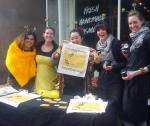
buzz fundraiserLush threw us a fundraiser in Oxford this weekend, raising £57 for us with sales of their Charity Pots.

Then we visited bike co-op Broken Spoke, and set out along the beautiful canal and Port Meadow and passed the ruins of Godstow Nunnery.

Further out we found Fai Farms providing artifical bee homes. You could provide living space for bees in a similar way. IMG_20140405_175550

We passed Wytham Woods a Site of Special Scientific Interest where the habitat is being preserved.

In total the four of us walked about 35km, mostly on the second day which was a good long IMG_20140405_153142practice!

Insight Share donates video equipment

Thank you to Participatory Video experts Insight Share in Oxford who have donated a video camera to us for the walk! We’ll be using it to create a higher quality short documentary of the tour. The first part of which we aim to screen for the first time on 20-22nd June at the Tandem environment and music festival in Oxford.

102_1455Operations Manager Marleen Bovenmars introduces Participatory Video:

The way we do it is straight away to hand over the camera and they tell their own story through activities and games. So they’re learning straight away. Once they have the basic skills we help them with storyboarding.

A storyboard consists of pictures representing video scenes, to help plan and visualize the shooting of the footage.


Seeds For Change and consensus decision making

We spoke to Richard Howlett from Seeds For Change in Oxford about their work providing training and resources for grassroots activists.

Richard Howlett from Seeds for Change

Richard Howlett from Seeds for Change

We believe in bottom up change, that we should have power and responsibility for our own lives, and collective action is more powerful than individual action. That is a reflection of how we go about learning – as facilitators rather than teachers. We’re trying to help the learning come up through you. It’s pragmatic but it’s also political and ideological too. Doing something real, that’s where you are really going to learn.

Amongst the very useful things that Richard shared with us were information booklets about facilitation skills and consensus decision making – very handy for the walk!

Consensus decision making is a process where the group as a whole can come to agree to a proposal rather than just a majority vote. With proper facilitation the process can be more successful and democratic than traditional group decision making.

Oxford – city of spokes

On our practice walk this weekend we visited the biking co-operative Broken Spokes in Oxford. Co-founder Elle Smith tells us about forming the group.

One of the striking things about a visit to Oxford is the thousands of bikes, chained to everything. It’s common to see women in skirts and smartly dressed people cycling to work, as well as the thousands of students. Broken Spokes savages bike and helps people repair their own bikes by providing knowledge, space and tools. They also help people to take up  cycling, and provides a great community hub. We meet Owen who is cycling to Austrailia and Dave Thomas, Green Party Candidate for Holywell Ward Oxford.

Walk and Lush fundraiser this week in Oxford

This weekend the kind people at Oxford’s Lush store on Cornmarket Street are throwing the Buzz Tour a Charity Pot Party fundraiser! The store’s manager James Atherton explains.

All the weekend’s sales from their Charity Pot’s will be donated to The Buzz Tour! We’ll be at the store until 1pm on Saturday so you can come and ask us more about the tour.

Then at 1pm we’ll be leaving on our second practice walk and you are welcome to come with us! If you want to walk for a few hours, just turn up but if you’d like to walk the whole weekend let us know in advance to help us plan. 🙂